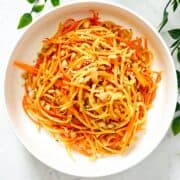
Carrot Pasta
Blog: www.nextinlime.com
Servings: 4 people
Ingredients
- 2 large carrots, shredded (or 3 heaping cups of shredded carrots) - around 300 grams or 10 ounces
- 8 ounces (227 g) pasta - any pasta of your choice
- 1 tablespoon olive oil - or any cooking oil you prefer
- 3 cloves garlic, minced or grated - around 2 teaspoons of minced garlic
- 3 tablespoons roasted and salted peanuts, crushed - see Note 1 below
- some sesame seeds for garnish - optional
For the Sauce
- 2 tablespoons soy sauce - see Note 2 below
- 1 teaspoon sesame oil - roasted sesame oil will also work
- 1 teaspoon sriracha - adjust the quantity to taste
- 1 tablespoon freshly grated ginger
- 1 teaspoon distilled white vinegar - see Note 3 below
- 1 teaspoon black pepper - freshly cracked
- 1 teaspoon chicken bouillon powder - see Note 4 below
- ½ teaspoon sugar - brown or white
- ¼ cup (59 ml) water
Instructions
- In a bowl, mix all the ingredients for the sauce (soy sauce, sesame oil, sriracha, ginger, vinegar, black pepper, chicken bouillon, sugar, and water). Stir well and set aside.
- Boil the pasta as per the package instructions. Drain and set aside.
- Heat the olive oil in a wide pan, wok, or skillet over medium-low heat.
- Add the garlic and stir for 30 seconds.
- Then add the shredded carrots and cook for 2 to 3 minutes.
- Add the boiled and drained pasta to the pan.
- Mix the sauce again and add it to the pan. Give everything a good but gentle mix.
- Turn off the heat. Dish out the pasta, sprinkle sesame seeds and crushed peanuts, and enjoy.
Notes
- Note 1: Peanuts - crush the peanuts using a pestle and mortar. Or put some peanuts in a ziploc bag and crush them using the flat side of a small saucepan. Don't crush them too small. Crushed, roasted cashews can be used as a substitute.
- Note 2: Soy Sauce - use tamari instead as a gluten-free option.
- Note 3: Vinegar - an equal quantity of lime or lemon juice can be used as a substitute.
- Note 4: Chicken Bouillon - you can also use chicken bouillon cubes. Or substitute with vegetable bouillon to make this dish vegan or vegetarian. A single 4 to 5 gram cube is equivalent to 1 teaspoon of bouillon powder. However, check the box of your bouillon cube to be sure. Use no more than the amount needed to produce 1 cup of stock or broth to replace 1 teaspoon of bouillon powder. If you are not careful with the quantity, your food may become too salty.