

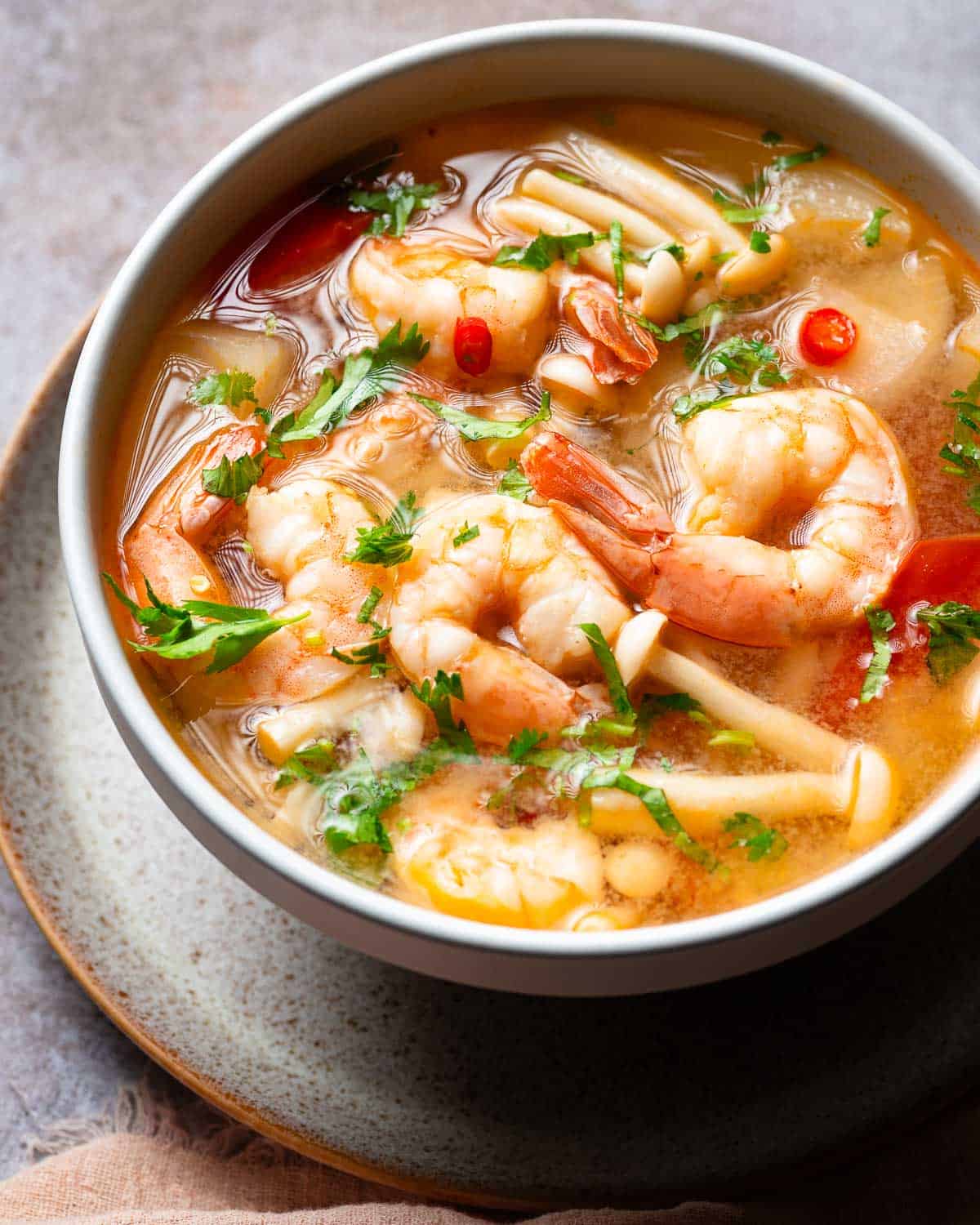
Tom Yum is the undisputed star of Thai soups. It’s one of those dishes that’s made its way all around the world and today I'm sharing with you my way of making it at home. It's tangy, it's umami, bright, and delicious. You can make it with different proteins, but shrimp is probably the most common one, and that’s what I like to use too.
When I first started making this soup over a decade ago, I went down a rabbit hole trying to figure out how it’s traditionally made. Watched a ton of videos and went through at least 20 recipes I found on Google.
But like any classic dish, I realized there isn’t one definitive recipe. The common denominator across the different versions, though, is the use of fresh lemongrass, galangal, makrut lime leaves, chilies, fish sauce, cilantro, and, importantly, a nice flavorful broth.
That broth is usually either chicken or shrimp, and traditionally, it’s made from scratch, which is how I used to make it. But then very recently I came across a Chef Jet Tila recipe video, where he mentioned that many restaurants use chicken powder nowadays. Making chicken stock from scratch takes time, and making shrimp stock with shells and heads takes even more effort. I didn't need any more convincing to embrace the shortcut.
Over the years, I’ve made this soup a few different ways. I’ve already shared a Tom Yum noodle soup version, and I also make creamy versions using either evaporated milk or coconut milk. But today, I’m sharing the recipe of clear soup, Tom Yum Nam Sai.
Well, technically, it's Tom Yum Goong Nam Sai. “Nam Sai” since it's got a clear broth, “Goong” because we're using shrimp. The protein can vary, and so can the name depending on the variation.
The process of making it is super simple and easy. I start by simmering the aromatics in water, giving them time to release all their flavor. Once they’ve done their job, I strain them out. From there, I build the soup by adding the chicken powder, chili paste, mushrooms, tomatoes, onions, and shrimp at different stages over the next few minutes.
The fish sauce, lime juice, and cilantro go in at the very end because excessive heat can dampen those bright, fresh flavors that make this soup extra special.
The best part about using shrimp is how quickly it cooks. It only needs about 2 to 3 minutes. Once your broth is ready, the soup comes together incredibly fast, so make sure all your prep is finished before you start cooking.
Pre-cooking notes and tips
If you know your way around these ingredients and Thai cuisine, you can jump straight to the recipe card. For everyone else, I’ve gone a little deeper into the details below to help you feel confident making this iconic soup.
- Lemongrass, makrut lime leaves, galangal, and Thai red chilies are easy to find at Southeast Asian grocery stores. They’re available both fresh and frozen. Either works well. I’d avoid pastes or minced versions.
- I’ve also come across pre-portioned frozen bags that contain these four aromatics specifically for packaged tom yum soup. Convenient, yes, but I find that the quantity balance is often off. And when you add it all up, these aromatics end up costing quite a bit for the overall amount you get. I prefer buying everything separately.
- Lime leaves can also be found in the freezer aisle, but I prefer them fresh. Their flavor is brighter and more pronounced compared to frozen ones, although frozen works fine too. Don’t use dried leaves.
- When prepping lemongrass, trim off the dry, stiff top portion and the tough, bulb-like root end. Peel away the outer layer, cut the remaining stalk into 2-inch pieces, then use as needed.
- I get frozen stalks of lemongrass that already have the root end and the dry top portion trimmed off. Saves me a little bit of prep, and you can take out what you need and stash the rest back in the freezer.
- Galangal looks similar to ginger, but tastes very, very different and cannot be used interchangeably. I buy whole frozen galangal.
- When buying these aromatics frozen, look for vacuum-sealed packs if they’re available. Because I’m me, I also check a few and grab the one that looks the most tightly sealed. Vacuum sealing helps prevent freezer burn and does a better job of preserving the flavor.
- When I bring the four aromatics home, I portion them out into small tight packs using plastic wrap. Since I cook a variety of Thai and Asian dishes, like my arroz caldo that also uses lemongrass, I keep each one separate. Lemongrass packs in one bag, galangal packs in another, and so on.
- If you’re buying these ingredients just for tom yum, I’d portion them out into ready-to-use packs for one batch of soup.
- Nam Prik Pao is a classic Thai chili paste and one of the key ingredients in tom yum. It’s not something I’d skip. In Asian grocery stores, jars are usually labeled either “chili paste” or “chili paste with/in oil.” To make sure you’re getting the right kind, look for those made in Thailand. I get the Pantai brand (not sponsored).
- Fish sauce has a strong smell and flavor on its own, but don’t let that put you off. Used in the right amount, it adds a wonderful salty, umami flavor to the soup. A good quality fish sauce should have a short ingredient list, usually fish or anchovy extract, salt, sugar, and water. I use the Squid brand (again, not sponsored).
- Traditional tom yum is made with straw mushrooms, but I’ve used different kinds over the years, and most of them work fine. The one exception for me is shiitake. I find the flavor a little too noticeable, and it competes with other flavors in the soup.
- Personal favorite is white shimeji, aka beech mushrooms. They don’t need much prep, have a fairly neutral flavor, soak up the flavors of the soup, and have a pleasant bite.
- I’ve never used straw mushrooms because I’ve never been able to find fresh ones in stores here in Calgary. Also not a big fan of canned mushrooms, but if you want to use them, get whole peeled straw mushrooms.
- Different mushrooms need to be prepped differently. A quick search will tell you what to do depending on the type you’re using. For shimeji mushrooms, for example, I cut off the bottom cluster where all the stems are fused together. If that part has already been removed, I just trim off any brown, dried, or damaged ends. I usually leave them whole, but if you’re using a different, bigger mushroom, cut it into bite-sized pieces.
- Thai chilies work best for this soup. If you want to adjust the spice level, I’d change the amount of Thai chilies rather than swapping in another kind.
- This soup is also a great way to use up leftover rotisserie chicken. Throw it in at the same step where you’d add the shrimp. Since the chicken is already cooked, it only needs a quick warm-up.
- When I make this soup with raw chicken, I simmer bite-sized pieces of thighs in unsalted water until they’re fully cooked. Then I use that cooking liquid as the base for the soup instead of plain water while still adding the chicken powder. When I add fish sauce towards the end, I also stir in the cooked chicken.
- Your chicken powder may be different from mine. I use 8 cups of water in this recipe, but the chicken powder I use is measured for 6 cups of broth: 1 teaspoon per cup, which comes out to 2 tablespoons total. Check the instructions on the brand you’re using and use the amount recommended for 6 cups of broth.
- I don’t make or use shrimp broth. It’s a lot of work removing the shells, heads, and tails, simmering them, and putting in that extra time. For me, the combination of fish sauce and chili paste brings enough umami and seafood flavor to the soup. That gets an extra boost when the raw shrimp cook directly in the broth.
- I buy raw, peeled, deveined, tail-on frozen shrimp, but tail-off works too. No prep needed.
- Traditionally, lemongrass, galangal, and lime leaves are all left in the soup. Locals know not to eat them, but your guests might not, so give them a heads-up.
- Personally, I prefer taking them out. I use a spider strainer, or I pass the broth through a fine-mesh strainer.
Serving ideas
Tom yum is traditionally enjoyed with jasmine rice, with the soup spooned over the rice a little at a time. I’m always stocked with basmati rice, so that’s what I usually serve it with instead. Fried rice works well too. That said, tom yum can absolutely be enjoyed as a soup just on its own.
You can turn it into a noodle soup by adding Thai rice noodles. Those noodles cook real fast, so read the package directions.
Thai omelette is another dish that’s commonly paired with tom yum.
Very untraditional, but I love dunking toasted crusty bread or sourdough into the broth. The first time I did it, Samad gave me a side eye. Then he tried it, smiled, and I gave him a side eye right back.
Grilled meat pairs really well too, as long as it doesn’t have strong flavors that compete with the soup.
Quick note on leftovers. When I reheat tom yum the next day, I find that the tang mellows out a bit, so I add a little more lime.
And that's a wrap!
Phew, we covered a lot here, but I hope you’re walking away with everything you need to get a great result. Give this one a try, it's going to surprise you in all the good ways. And if you do make it, I’d love to hear your thoughts. Drop a comment and a rating below.
Happy cooking ~ Nelo
Tom Yum Soup Recipe
Ingredients
- 3 stalks of fresh lemongrass - cut into 2-inch pieces (see Note A below)
- 10 kaffir/makrut lime leaves - roughly hand-torn
- 2 inch piece of galangal - cut into thin slices
- 2 small Thai red chilies - cut into halves or thirds, adjust quantity to taste
- 2 tablespoons chicken powder - (Note B)
- 2 tablespoons Thai chili paste - aka nam prik pao (Note C)
- 5 ounces (140 g) fresh mushrooms - I use white shemiji/beech mushrooms (Note D)
- 1 medium tomato - cut into wedges, I use Roma tomatoes
- 1 medium onion - cut into bite-sized pieces
- 8 ounces (225 g) raw shrimp / prawns - peeled and deveined, tail-on or tail-off (weighed after thawing)
- 3 tablespoons fish sauce - (Note E)
- 8 tablespoons lime juice - this soup is boldly sour
- ¼ packed cup of chopped fresh cilantro - aka coriander
Instructions
- Bring 8 cups of water to boil in a stock pot over high heat. Add lemongrass, lime leaves, galangal and Thai chilies. When it's boiling again, reduce the heat to maintain a gentle simmer and cook covered for 20 minutes.
- I strain out the aromatics for a clear broth. You can leave them in as is traditionally done. They are not to be eaten, so warn your guests if you don't remove them.
- Adjust heat to medium-high and to the simmering broth, add chicken powder, Thai chili paste (nam prik pao) and mushrooms. Cook for 5 minutes.
- Increase the heat to bring the soup to a boil, add tomato and onion and cook for 2 minutes.
- When the soup is boiling again, add shrimp/prawns and fish sauce and cook for another 2 minutes or just until the shrimp turn opaque. Turn off the heat, add lime juice.
- Taste the soup. For more spice, add finely minced Thai chilies. To increase saltiness, add fish sauce or regular salt. For more tang, add lime juice. Make any adjustments in very small increments.
- Mix in cilantro, let the soup rest for 2 minutes and serve.

Comments
No Comments